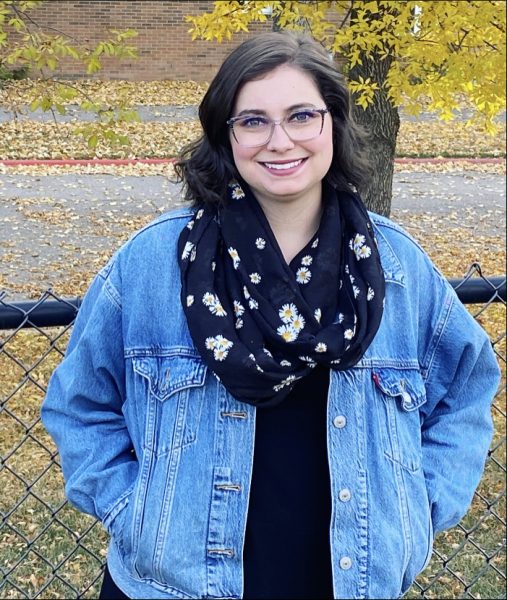
Michel kicks off The City Project!

An author interview with Michel Durand-Wood about his new book, You’ll Pay For This, and how he keeps municipal finance fun

Great Plains Press’ Angeline Javier sat down with author Michel Durand-Wood to talk about his book and why understanding your city’s budget is the first step to building a better city!
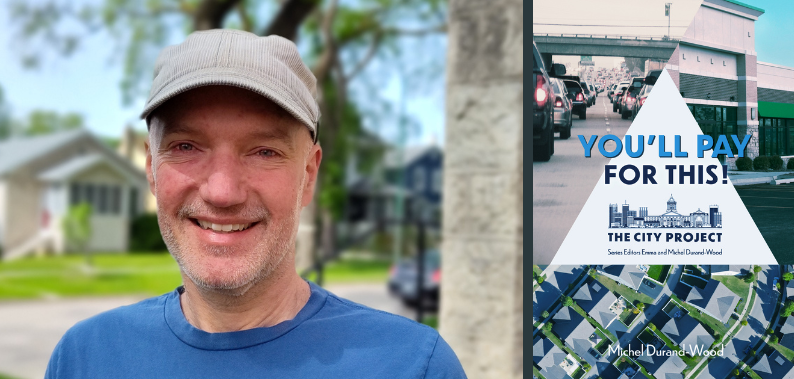
Two images side by side. On the left, Michel's headshot. He's a friendly looking guy in his 40s. White, wearing a blue shirt and ball cap. On the right, the cover of You'll Pay For This. It features three images: bumper to bumper traffic, a dead strip mall and an ariel view of suburban sprawl.

Angeline: Can you tell us about The City Project series?

Michel: The city project is a series of books that are all meant to be an introduction to a different aspect of building a sustainable, thriving city. 

And so each of the books are about 100 pages and are meant to be read in an afternoon. My book You’ll Pay for This is on municipal finance, and I promise it’s way more fun than it sounds.

It’s also super important because it is the basis for everything else, right? We can’t talk about any of the other things of building a city without knowing how we’re going to pay for it. So, my book is about how we can make sure that we have a financially sustainable city, in a way that’s super readable for just the average person.

It’s easy to have talks about these different subjects that go into a lot of different jargon and become hard to understand for the layperson. It’s a good introduction so that we can all sort of have these discussions about how we want our city to look.

Angeline: Why was it important for you to implement a comedic tone to your writing?

Michel: I have a blog that I’ve been writing for seven years now called Dear Winnipeg, and it is a blog about infrastructure and municipal finance.

 And when I first started it, I really put a lot of thought into it. I was actually pretty inspired by people like Jon Stewart and The Daily Show, Bill Nye the Science Guy and Alton Brown with Good Eats. They all had these shows where, you know, they were giving you a lot of useful information, but it was done in a really entertaining way. 

And I thought that was pretty important, especially for something like municipal finance, which, you know, people’s eyes glaze over as soon as you say the words. 

For me, it was important to make it accessible, fun and engaging, and humor was a good way to do that. That’s also kind of my own personality too. So, it just fits nicely that way. 

“People are naturally disarmed when you make them laugh. It makes them more open to receiving what you’re trying to tell them.” 

Angeline: You used Winnipeg as a case study, but what do you hope readers from other provinces, states and cities take away from your book?

Michel: Yeah, of course I’m writing about Winnipeg. It’s where I live, and it’s what I know, deeply. But, the reality is, the concepts that I talk about are applicable to basically every city in North America. We’ve been growing our cities, pretty much identically, using the same types of patterns, using the same types of rules.

For the past 70 or 80 years, we just sort of copied off of each other. And so what Winnipeg is facing is not unique at all. Every city in North America is at a different stage of the same financial illness.

I’ve had many people already tell me on my blog that they’re reading about Winnipeg, but it really feels like they’re reading about their own city. I’m hoping that’ll be the same with the book, that people will read it and really pull away the same lessons that are applicable to their own places. 

Angeline: What do you hope for with the future of The City Project? 

Michel: I’m really hoping to touch on all the different aspects of building a prosperous city. There’s a lot that goes into it. People can get involved in making their city a better place, but they’re interested in different things and have different skill levels. 

Angeline: Do you have any writing tips that you’d like to share? 

Michel: The biggest one for me is setting deadlines. If I don’t have a deadline, for myself, I just will not get to it a lot. A lot of the time. And the other thing is just when it’s time to sit down and write, and just let it all out. Otherwise, it’s too easy to get locked up on a particular part of it. 

But I’m new to this professional writing business, so. So I would say, do what works for you. It’s probably the best. 

Angeline: As a first time author, what would you say to your younger self about your career now?

I’ve never considered myself a writer or an author, but, I mean, it’s clear that I am. This is my first book, but obviously I’ve been writing on my blog for a long time. I’ve also had writing published on several other outlets. 

I’ve never identified with being a writer. I think my goal has always just been to educate people. So maybe I’m an educator who writes. And so with that, if I had to give my past self some advice, I think, oftentimes you start off with some goals in life or something you’re trying to achieve. Whether that’s helping the people in your city understand certain topics, you may need to pick up some skills that you didn’t have before, in order to achieve that.

Place Your Bets!

An author interview with Lee Kvern about her new political thriller, Catch You On The Flipside

Great Plains Press’ Angeline Javier sat down with author Lee Kvern to talk about her new novel and top advice for new writers.

two images side by side. On the left, an image of Lee. She is sitting with two card decks balanced in her hand. She has short, red hair and is smiling. She's lit by natural sunlight. On the right is the cover of Catch You On The Flipside.

Angeline: What inspired you to write Catch You On The Flipside?

Lee:  Catch You on The Flipside comes from my experience working in the casinos in my early 20s, for about a decade and a half. I always wanted to write about the casino, but I couldn’t find a hook. Then I started to think about some of the various stories and characters that I worked with at the casino, and it’s just an absolute goldmine.

I started thinking about some of the people that we used to hang out with, and one of the people that came to mind was a friend that immigrated from the Philippines, and we took the same blackjack course together.

We worked together for about two years and were good friends, we all went out for drinks and food and stuff like that. Then one day, just out of the blue, the Attorney General’s office in charge of gaming came in and escorted my friend out ofthe casino.

I’ve never seen him since that day. And of course, we were all shocked. We didn’t know what was going on. And then over the course of time, we started to find out the details. I can’t talk about it too much without giving the book away. But while I was worrying about fighting with my boyfriend at the time who was going to clean the bathtub, my friend was involved in something much more crucial. I think I’ll leave it at that. Yeah. That’s kind of the impetus for the book.

A: The book was inspired by personal experience, but also by historical fact. What did the research for this story look like?

L: This is the first book that I had to do heavy, heavy research on. So it’s unlike all my other books, which are kind of literary fiction. This one is based on historical fact– the People’s Power Movement that happened in the Philippines in 1983 and onward, when the people overthrew the Marcos government.

I had a friend that I was staying with in Vancouver, and we were staying with her, and her parents were living in the Philippines during the Marcos regime.

I interviewed them and I interviewed another couple that were politically active during that time. So,  they were just a wealth of information by giving me the sensibility and the fears of the control that Marcos had over the country. And really what a phenomenal movement that the [People’s Power] was.

They also gave me some really awesome books from that period, written from eyewitnesses that were crucial in helping to write this, because of course, I knew nothing.

So the book is a real hybrid of fiction and historical events that actually took place.

This was quite funny when I was staying with my girlfriend in Vancouver, she was going water walking with their parents.

They don’t have that here in Alberta, I haven’t seen it much. But in B.C. it’s big. It’s just a big oval pool, about waist deep and it’s warm. We were water walking with their parents every day. And so once I’d finished writing the book, I asked her parents, my friend and the other couple if they would look at the manuscript and tell me what resonated. 

So they looked at the manuscript the night before, and then we were water walking the next day. It was hysterical because there’s me, walking around the Oval and there’s like five people around me telling me all different things about what  is working in the book and what is not working. It’s the best critique and critical reading I’ve ever had on a book. It was just in such an unorthodox place, and they were so wonderful and so generous in sharing their experience with me. That for me was the highlight of the whole book.

A: Can you talk about how Catch You On The Flipside is such a timely story right now?

L: Yeah, that’s so bang on. I mean, essentially what happened in the 80s with the People’s Power and the Marcos regime was just the boiling frog syndrome that started off with the seemingly democratic government and then that government started to take control of everything until you have martial law and a dictatorship.

And I mean, that’s so what’s going on right now? Certainly south of us, in the U.S. It’s important to be aware that it’s happened in history. In the Philippines, Marcos’ regime lasted 20 years, and it devastated the country.

I think it’s something we have to pay attention to and something that we have to get loud about. We have to stand up for ourselves as democratic people, before the water starts to boil.

That’s one of the other things that I really enjoyed about writing the book, is the sort of intersectionality of having friends from other countries and other political systems. I mean, how would you ever know that stuff unless you were hanging around with people from outside your own bubble?

A: What would you say to your younger self about your career now?

L: I laughed when you sent me that question because the idea of a career always brings to mind that you get paid for it, right?

I’ve been in this writing game for a long time, for about 30 years. And I guess it’s a career. But what I would tell my younger self is, and it took me a long time to learn this, is to get a regular job, and don’t try and make your art pay for it.

“Don’t try and commodify your art because it’s just so difficult. I mean, you’re always subsidizing yourself.” 

Certainly my stress was taken away once I learned that. And so then when I came to my writing, I wasn’t under that pressure to commodify it or to make money from it. I was actually doing it because I wanted to do it and I love to do it.

A: Do you have any tips for writers?

L: This is all from my own experience, and every writer is going to tell you something different. For me, the most important thing was learning my craft.

“I think it’s a mistaken idea that just because you can write a letter, you can write a story.”

I learned that the hard way. I wrote for about ten years, without learning any craft, and just kept getting rejected over and over and over. It wasn’t until I got serious about it and decided I was going to start doing mentorship programs and taking courses and getting together with other writers and workshopping, I started to develop my craft in order to tell a story, to put what was in my head down on a page.

That made all the difference in the world. That’s when I started to get acceptances and published stories. I think that’s one of the biggest tips I would say. It was the same as art college. I mean, for four years, that’s what we did: we learned the craft of art. Writing is no different.

Meet Lee Kvern at Calgary’s WordFest on May 8th. Get your tickets!

Join us for Talking Climate

Talking about climate change is a challenge in a world of political polarization and increasing anxiety. Four authors discuss their approach to the question: How do we talk about climate change?

We hear about the growing threat of climate change regularly in our day-to-day lives, be it forest fires, flooding, or oddly warm winters. At the same time, our systems are slow to change, with political polarization adding tension to an already complicated topic. For many, the situation can seem hopeless. 

Artists are using their craft and creativity to tackle this challenging topic. On Wednesday, June 5th, four notable writers of various backgrounds and styles met online to engage in a conversation with each other and their audience to answer today’s pressing question: How do we talk about climate change?

Talking Climate is a free event open to all. Audience members need to register to receive the webinar login details. A recording of the event will be posted following the event. 

Full Video Recording HERE

Talking Climate will feature:

  • Opening remarks from Bethany Damen, Communications Manager for Manitoba’s Climate Action Team, on Communicating about Climate in a Polarized World.
  • A discussion between JR (James) Burgmann, author of Children of Tomorrow; poet Ariel Gordon, author of Siteseeing; Katłı̨̀ą, author of Firekeeper; and Jason Pchajek, author of Bounty
  • Audience members will then be invited to ask their questions.

TALKING CLIMATE 

June 5, 2024 at 7PM Central Time

Full video on YouTube

*This event will take place as a zoom webinar, which will be streamed following the event.

Arielle Aaronson – Women in Translation Month

August is Women in Translation Month, an annual celebration of women writers from around the world writing in languages other than English. It’s also a chance to recognize the women who work to translate works from other languages into English in order to share those voices. This month, we want to share some words from Arielle Aaronson, translator of the recent translation of Marie-Renée Lavoie’s middle grade novel, The Curious Misadventures of Kitty the Cat. Here she explains a little bit of what it’s like to bring a story from one language into another.

“This is the fourth title by Marie-Renée Lavoie that I’ve translated. Every time I sit down with one of her books, it feels like I’m continuing a conversation with an old friend. I get to laugh at her humor and wit, but I’m also able to watch her characters and themes develop as her writing evolves. It’s a lot like sitting in the passenger seat for a very scenic drive. Often you can tell where the car is headed, sometimes you want to reach over and take the wheel, but mostly you act as a second pair of eyes and ears (or paws, in this case).

For this book, it was such fun to imagine the universe of a family pet. My task was threefold: I had to translate Marie-Renée’s words into English, create an English voice for Kitty himself, and develop a style that was accessible yet goofy enough to draw in younger readers. Some of my biggest challenges involved striking the right tone for a pun (would you believe it took me months to come up with”poo-tunia”?) or landing on a name like “Spitball.” If I’ve done my job right, you’ll fall in love with Kitty just as I did.”

Have you heard?

Our authors have gotten some great radio play this week!

Curious about why Angie Abdou asks “why isn’t Thomas Trofimuk a household name?” Listen to her audio review of This Is All A Lie on CBC Alberta! Following Angie’s rave review, Daybreak Alberta hosted Thomas for an interview, which you can listen to here.

Anne Mahon has committed her life making a difference. Let’s Give A Damn interviewed her about her volunteer work, and how that led to her commitment to share the stories of people in marginalized communities in her books The Lucky Ones and Redemption. Get ready to be inspired and check it out.

Spring Books are off!

GP_Gracelessland_cover_NEWThe sun is shining, the plants are blooming, and our authors are launching! Yes, spring is officially here.

Jodi Carmichael kicked off the release of Forever Julia with a standing-room-only launch event in McNally Robinson’s Atrium. Since then, she’s received an excellent review from The Winnipeg Free Press (“This is a young writer to watch”), and is garnering glowing feedback on her current blog tour (follow her adventures on her website).

Richard Cumyn also had a successful launch in Kingston for his collection of novellas, Famous Last Meals. Kathleen Winter calls this collection “a cross between Maurice Dekobra and Sir Arthur Conan Doyle.”

This week will see the launch of Gracelessland, our first Enfield & Wizenty novel since Méira Cook’s stunning The House On Sugarbush Road.  Adam Lindsay Honsinger’s coming of age, anti-hero mental hospital adventure had us glued to the page and we can’t wait to see what the rest of Canada thinks about this outstanding young writer!

Additional May launches include A Daytripper’s Guide to Manitoba, a completely revised edition from Bartley Kives, and On The Air: The Golden Age of Manitoba Radio by Garry Moir.  Both authors are booking media interviews and author signings already!

Teen Fiction Authors in the news

Our Great Plains Teen Fiction authors are keeping busy!

Colleen NelsonColleen Nelson was interviewed by Shaw TV here in Winnipeg about her new novel, The Fall. The clip will be airing on the station shortly, but you can get a sneak-peek here!

The Silent Summer of Kyle McGinley continues to garner great reviews.  The latest praise comes from Canadian Children’s Book News: “With his well-placed sarcasm and keen observations, Kyle is an authentic teen character that we immediately identify with.”  

Gail Sidonie Sobat’s Chance to Dance for You was part of Heather Milne’s review essay Isolation, Exploration, Affirmation: Dominant Patterns in Four Books for Gay Teens in the latest edition of Jeunesse.  She statesChance to Dance for You is a timely book in its focus on social media and technology as sites of bullying for gay teens, a topic that has been in the news of late due to a proliferation of highly publicized teen suicides and the popularity of the “It Gets Better” campaign, which attempts to offer a sense of hope to depressed and isolated teenagers.”

Visit a bookstore near you to pick up copies of these titles today!

Richard Van Camp on The Next Chapter

Richard Van Camp was interviewed by Shelagh Roger’s on CBC Radio’s The Next Chapter.

Listen to the interview now to hear about Richard’s writing process and how his Dogrib (Tlicho) background and his love for the north influence his writing. Also hear how he describes Enfield & Wizenty editor Maurice Mierau as a “warrior poet!”

The Lesser Blessed, based on Richard’s novel, is now playing at The Globe theatre in Winnipeg. Read the glowing review from the Winnipeg Free Press here!